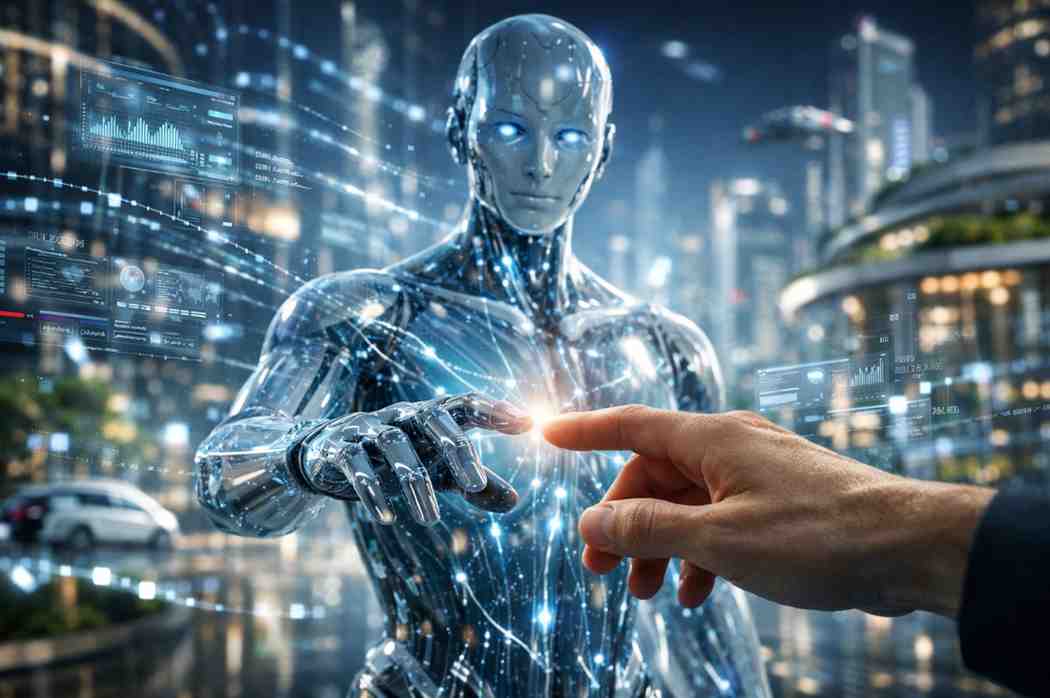
In the modern world, few concepts have captured the imagination and transformed industries as profoundly as Artificial Intelligence. From voice assistants on our phones to advanced medical diagnostics, AI is no longer a futuristic idea—it is a present-day reality reshaping how we live, work, and think.
What is Artificial Intelligence?
Artificial Intelligence (AI) refers to the ability of machines or software to perform tasks that typically require human intelligence. These tasks include:
- Learning from data
- Recognizing patterns
- Understanding language
- Making decisions
At its core, AI is about creating systems that can simulate human thinking and problem-solving—sometimes even exceeding human capabilities in specific domains.
A Brief History of AI
The concept of intelligent machines dates back decades. In 1956, the term “Artificial Intelligence” was formally introduced at the Dartmouth Conference, marking the birth of AI as an academic field.
Over time, AI evolved through several phases:
- Early rule-based systems
- Machine learning breakthroughs in the late 20th century
- Deep learning and neural networks in the 21st century
Today, AI is powered by massive datasets and high-performance computing, enabling rapid advancements across industries.
How AI Works
1. Machine Learning
A subset of AI where systems learn from data instead of being explicitly programmed.
2. Deep Learning
Inspired by the human brain, deep learning uses neural networks with many layers to process complex data like images and speech.
3. Natural Language Processing (NLP)
This allows machines to understand and generate human language—powering tools like chatbots and translation apps.
Real-World Applications
AI is everywhere, often working behind the scenes:
Healthcare
- Diagnosing diseases
- Predicting patient outcomes
- Assisting in surgeries
Finance
- Fraud detection
- Algorithmic trading
- Credit scoring
Transportation
- Self-driving cars
- Traffic prediction systems
Everyday Life
- Voice assistants
- Recommendation systems (like on streaming platforms)
- Smart home devices
Companies like Google, Microsoft, and OpenAI are at the forefront of developing and deploying AI technologies.
Benefits of Artificial Intelligence
- Efficiency: Automates repetitive tasks
- Accuracy: Reduces human error in data-driven processes
- Speed: Processes vast amounts of information quickly
- Innovation: Enables new products and services
In many ways, AI acts as a powerful tool that amplifies human potential.
Challenges and Concerns
Job Displacement
Automation may replace certain types of jobs, requiring workforce adaptation.
Ethical Issues
Concerns about bias, fairness, and decision-making transparency.
Privacy
AI systems often rely on large amounts of personal data.
Control and Safety
Ensuring that AI systems behave as intended and do not cause harm.
The Future of AI
The future of Artificial Intelligence is both exciting and uncertain. Potential developments include:
- More advanced human-AI collaboration
- Breakthroughs in healthcare and science
- Smarter cities and infrastructure
- Continued debates around ethics and governance
Some experts believe we may eventually reach Artificial General Intelligence (AGI)—machines capable of performing any intellectual task a human can do.
AI in Everyday Life: Closer Than You Think
You don’t need to be a scientist to interact with AI. Every day, people use AI when they:
- Unlock their phones with facial recognition
- Ask virtual assistants questions
- Receive personalized recommendations online
AI has quietly become a part of daily life, often without us even noticing.
Why AI Matters
Artificial Intelligence is not just a technological trend—it is a fundamental shift in how humans interact with machines. It has the potential to:
- Solve complex global problems
- Improve quality of life
- Transform economies and societies
At the same time, it challenges us to think carefully about how we design, use, and regulate powerful technologies.
Final Thoughts
Artificial Intelligence is one of the defining innovations of our time. Like electricity or the internet before it, it is a transformative force that will continue to evolve and influence every aspect of human life.
The question is not whether AI will shape the future—it already is. The real question is how we choose to shape AI in return.
As we move forward, balancing innovation with responsibility will be key to ensuring that AI benefits everyone.