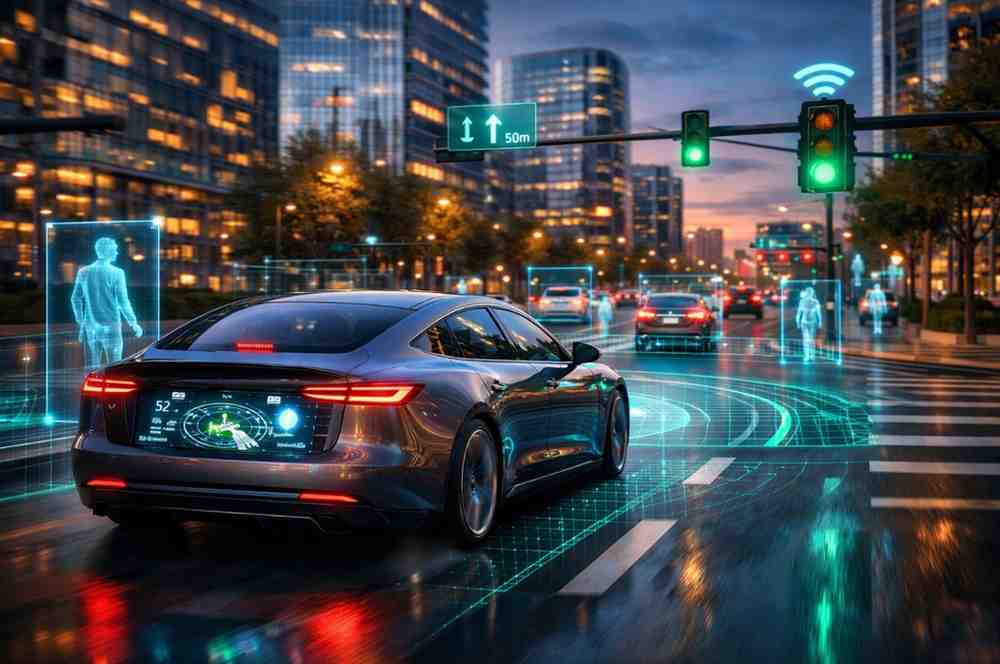
The idea of cars driving themselves once belonged purely to science fiction. Today, thanks to rapid advances in Autonomous Vehicles, that vision is becoming a reality. From experimental prototypes to real-world deployment, autonomous vehicles (AVs) are poised to transform transportation as we know it.
What Are Autonomous Vehicles?
Autonomous vehicles, also known as self-driving cars, are vehicles capable of sensing their environment and operating without human intervention. Using a combination of sensors, software, and intelligent algorithms, these vehicles can:
- Navigate roads
- Avoid obstacles
- Follow traffic rules
- Make real-time decisions
The goal is to create a system that can safely and efficiently replace or assist human drivers.
Levels of Autonomy
Autonomous driving is categorized into levels, ranging from no automation to full automation:
- Level 0: No automation (fully human-driven)
- Level 1–2: Driver assistance (e.g., cruise control, lane assist)
- Level 3: Conditional automation (car can handle most tasks, but human intervention may be needed)
- Level 4: High automation (no human needed in certain conditions)
- Level 5: Full automation (completely driverless in all environments)
Most vehicles on the road today are at Levels 1 or 2, while higher levels are still under development.
How Autonomous Vehicles Work
Sensors and Hardware
- Cameras
- Radar
- LiDAR (Light Detection and Ranging)
These help the vehicle “see” its surroundings.
Artificial Intelligence
Powered by Artificial Intelligence, AV systems analyze data, recognize patterns, and make decisions in real time.
Mapping and GPS
High-definition maps and precise positioning systems guide navigation.
Connectivity
Vehicles often communicate with other vehicles and infrastructure (V2X communication).
Key Players in the Industry
Several companies are leading the development of autonomous vehicles:
- Tesla – Known for its Autopilot and Full Self-Driving features
- Waymo – A pioneer in fully autonomous ride-hailing services
- Uber – Investing in autonomous mobility solutions
- Toyota – Integrating automation into consumer vehicles
These companies are pushing the boundaries of what’s possible in mobility.
Benefits of Autonomous Vehicles
- Improved Safety: Human error causes the majority of road accidents. AVs can reduce these through precise, data-driven decisions.
- Increased Efficiency: Optimized driving can reduce traffic congestion and fuel consumption.
- Accessibility: People who cannot drive—such as the elderly or disabled—can gain greater independence.
- Time Savings: Passengers can use travel time for work, relaxation, or entertainment.
Challenges and Concerns
Safety and Reliability
Ensuring AVs can handle all real-world scenarios is a complex challenge.
Legal and Regulatory Issues
Laws and liability frameworks are still evolving.
Ethical Dilemmas
Decisions in unavoidable accident scenarios raise moral questions.
Cybersecurity Risks
Like all connected systems, AVs are vulnerable to hacking, making Cybersecurity crucial.
Real-World Applications
Autonomous technology is already being tested and used in various ways:
- Self-driving taxis in select cities
- Autonomous delivery vehicles
- Driver-assist features in modern cars
- Smart public transportation systems
These applications are early steps toward a fully autonomous future.
The Future of Mobility
The future of autonomous vehicles is closely tied to broader innovations like:
- Smart cities
- Electric vehicles
- Connected infrastructure
As these technologies evolve together, transportation could become safer, cleaner, and more efficient.
Autonomous Vehicles in Daily Life
While fully autonomous cars are not yet widespread, elements of the technology are already part of everyday driving:
- Adaptive cruise control
- Automatic emergency braking
- Lane-keeping assistance
These features are gradually paving the way for complete automation.
Why Autonomous Vehicles Matter
Autonomous vehicles represent more than just a technological advancement—they signal a shift in how society approaches mobility. They have the potential to:
- Reduce accidents
- Transform urban planning
- Change the concept of car ownership
- Lower environmental impact
Final Thoughts
Autonomous Vehicles are steering us toward a future where transportation is smarter, safer, and more inclusive. While challenges remain, the progress made so far suggests that fully self-driving cars are not a question of if, but when.
As innovation continues, the road ahead promises exciting possibilities—where cars don’t just take us places, but redefine the journey itself.